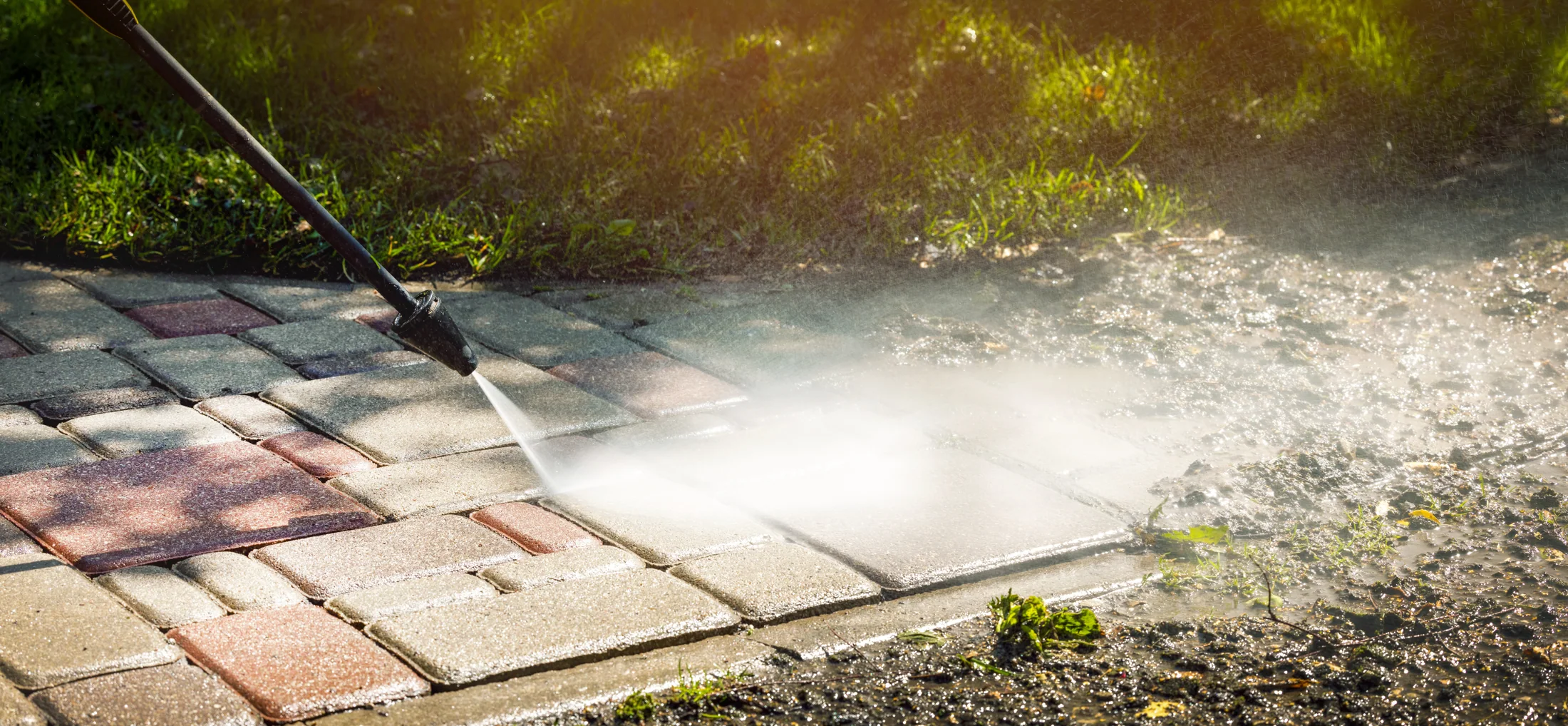
Pressure washing is worth considering when a driveway has accumulated dirt, algae, moss or other removable surface contamination and its construction can withstand the proposed cleaning method. It is not automatically the best option for loose gravel, damaged paving, unstable jointing or stains that have penetrated the surface. The decision should begin with the driveway material, its condition and the result you actually want.
For homeowners comparing cleaning options, the central question is whether water pressure will remove the unwanted material without compromising the paving or the way the driveway drains. A visibly dirty driveway does not necessarily need the most forceful treatment available.
Start with the driveway construction
Two driveways can appear similarly dirty but require substantially different cleaning approaches. The important differences are how the surface is made, whether it contains joints, how firmly the material is bonded and where the cleaning water will go.
Concrete and dense paved surfaces
Sound concrete and suitable dense paving may respond well to controlled washing where contamination is predominantly on the surface. Dirt lodged in surface texture can be loosened and removed, revealing the underlying finish.
However, concrete that is cracked, flaking or deteriorating needs closer assessment. Cleaning removes contamination; it cannot restore defective concrete. An aggressive jet may dislodge already weakened material or expose defects that were previously concealed by dirt.
Block paving
Block-paved driveways comprise individual units separated by joints. These joints help maintain the stability of the paving, but drainage depends on its construction. Conventional block paving generally sheds water across the surface, while permeable block paving is designed to let water pass through its joints and underlying layers. Washing can remove accumulated grime from suitable blocks, but it may also displace loose jointing sand.
Before agreeing the work, establish whether the joints are intact, whether blocks have moved and whether replenishing jointing material is part of the proposed scope. Washing and subsequent joint maintenance are separate activities. A quotation that only describes the washed appearance may leave an important part of the driveway condition unresolved.
Resin-bound, porous and other specialist surfaces
Permeable surfaces are designed to allow water to pass through their construction. This makes clogging a different problem from ordinary surface staining. A method that removes visible dirt may still leave fine material trapped within the surface structure.
The government’s guidance on permeable surfacing of front gardens explains that permeable driveway systems require appropriate maintenance and that some porous surfaces can be unclogged using suitable vacuum sweeping or jet washing. This does not mean every proprietary surface tolerates the same pressure or cleaning attachment.
The surface specification and its present condition should guide method selection. Loose gravel generally calls for a different approach because its individual stones are not fixed into a continuous surface.
When is pressure washing better than brushing or targeted cleaning?
Brushing and collection can be sufficient where the problem is mainly leaves, dust, loose mud or recently deposited debris. Removing these materials before they become embedded also reduces the amount of water needed during later cleaning.
Pressure washing becomes more relevant when removable contamination adheres to a suitable surface or accumulates within its texture. The choice depends on how much surface area is affected and whether a trial indicates that washing can achieve a worthwhile improvement.
- Loose debris: Sweeping or collection may be enough without pressure washing.
- Widespread surface grime: Controlled washing may be appropriate where the paving is sound.
- Localised oil staining: Targeted treatment and assessment of absorbed contamination may be more useful than washing the entire driveway.
- Damaged or moving paving: Repairs or stabilisation may be needed before cleaning is considered.
- Blocked permeable paving: The cleaning choice should address permeability, not merely appearance.
If you are considering driveway pressure washing, check the paving material, its condition and the type of dirt before choosing a cleaning method. These factors matter more than simply asking for the highest pressure available.
How do you know whether the cleaning method is suitable?
A representative test area can show how the surface responds to the proposed method. It should include the actual contamination and paving condition found across the driveway, rather than only a relatively clean corner.
The assessment should consider three separate results: whether the contamination is removed, whether the surface or joints change and whether the cleaning water can be managed appropriately.
Inspect the test area after it has dried. Dry conditions make it easier to identify changes in texture, disturbed joints or remaining contamination. If the surface shows damage, increasing pressure is not a sensible substitute for reconsidering the method.
A test also helps separate the cleaning objective from restoration expectations. Washing can remove material without recreating the colour or condition of newly installed paving. Where individual areas have weathered differently, the agreed outcome should concentrate on removable contamination rather than a promise of identical colour throughout.
What happens to drainage during driveway washing?
The water destination matters because some driveways drain into surface-water systems, while others are designed to allow rainfall to pass into the ground or adjacent landscaped areas.
Washing can move soil, sand and loose debris into gullies, drainage channels or permeable paving. Displacing material from the visible surface does not necessarily remove it from the property.
The government’s permeable paving guidance recommends removing leaves, mud and litter before they clog a driveway and avoiding the introduction of sand or soil into permeable surfaces. Where existing drainage connections are restricted, cleaning the paving will not by itself correct the underground problem.
For business-controlled premises or commercially contaminated areas, the Environment Agency’s pollution prevention guidance explains why contaminated cleaning water must be managed appropriately rather than directed into unsuitable surface-water drains. On a residential driveway, the practical starting point remains identifying the drainage route and the nature of material likely to be washed off.
What should be agreed before booking?
A useful cleaning specification is about outcomes and boundaries rather than pressure alone. Provide photographs showing the whole driveway and close-ups of staining, joints, cracks or loose areas. Identify the material where known and point out drainage channels, slopes and any neighbouring areas affected by runoff.
Ask the following questions:
- Which cleaning method is appropriate for the particular surface?
- Will the work include removal of loosened debris rather than displacement into drains or borders?
- Does block paving require separate jointing work afterwards?
- Are deeply absorbed stains outside the agreed cleaning outcome?
- What evidence will establish that the surface has been cleaned without unwanted changes?
Where the issue is instead a restriction in the connected drainage pipe, the drain jetting method selector provides a separate route for considering drainage obstructions. Surface washing and internal pipe cleaning address different problems.
For a driveway that is structurally suitable for washing, the best choice is the method that removes the relevant contamination while preserving the surface and its drainage function. More pressure is not automatically a better result.