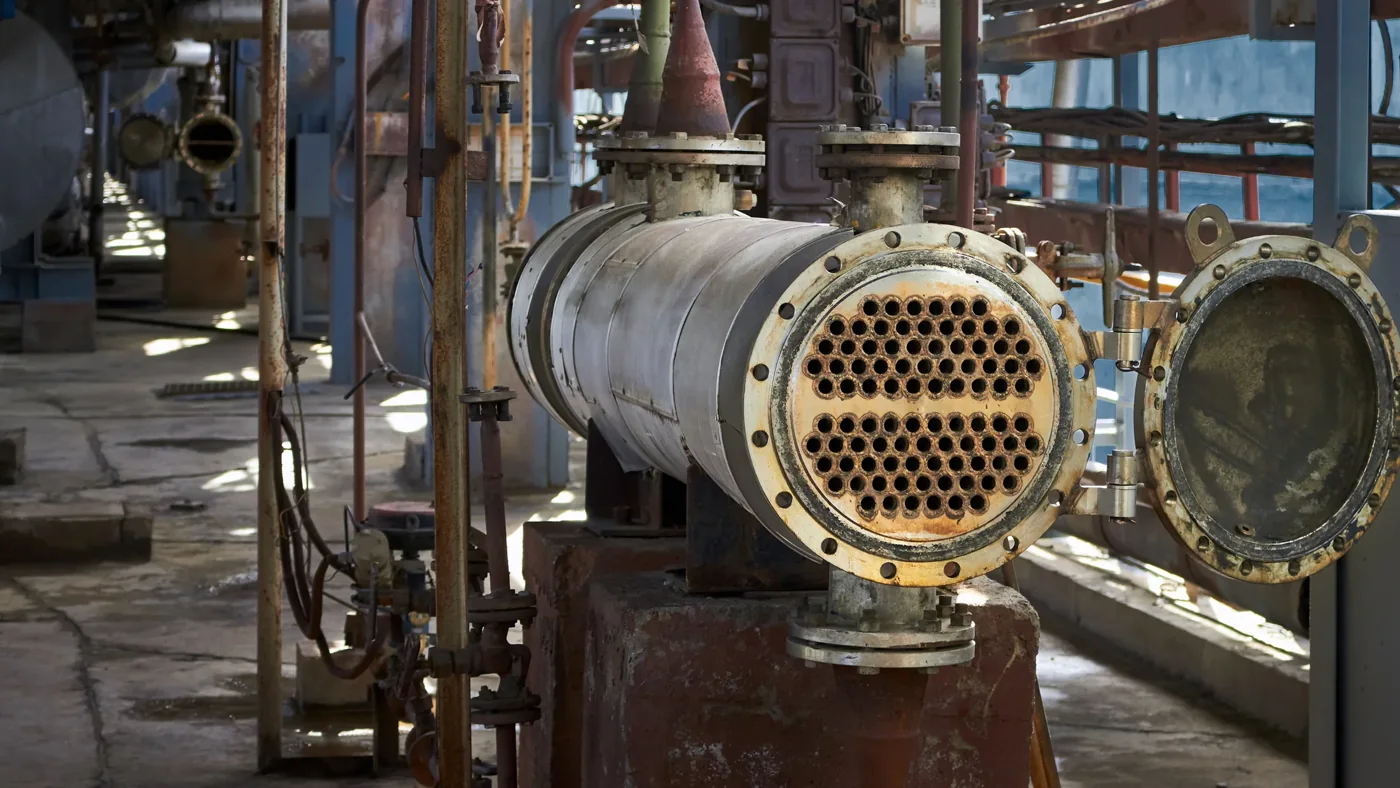
A heat exchanger can maintain its normal flow rate while transferring less heat because the surfaces separating the two fluids have become fouled. Deposits create additional resistance to heat transfer without necessarily obstructing enough of the flow passage to cause a noticeable hydraulic restriction. Normal flow therefore does not establish that an exchanger is clean or performing efficiently.
The important distinction is between the amount of fluid moving through the equipment and the amount of useful heating or cooling being achieved. A plant engineer needs both sets of information before deciding whether internal cleaning is justified.
Thermal symptoms without blocked flow
The government-published review of industrial heat decarbonisation identifies deposit build-up inside heat exchangers as a cause of declining efficiency. A performance investigation still needs to establish whether fouling explains the particular operating change.
Heat passes through the exchanger wall between fluids at different temperatures. Scale, sludge, biological deposits and process residues can form insulating layers on that wall. Even relatively thin deposits may reduce heat transfer where they cover a substantial working area.
Thermal fouling can become apparent through operating changes such as:
- A process outlet temperature moving progressively away from its normal operating value.
- A heating or cooling system taking longer to achieve the required temperature.
- Additional heating or refrigeration demand to maintain production conditions.
- Reduced thermal performance despite measured flow rates remaining close to previous operating values.
- A gradual deterioration between planned maintenance intervals.
These observations suggest reduced duty, but none proves that fouling is responsible. Changes in incoming fluid temperature, control valve operation, fluid properties or operating load can produce similar symptoms. Internal leakage between circuits can also affect performance and requires a different investigation.
Compare temperatures and pressure drop
A useful assessment begins with simultaneous readings from both sides of the exchanger. Record the hot-fluid inlet and outlet temperatures, the cold-fluid inlet and outlet temperatures, and the corresponding measured flow rates. Pump operation alone does not confirm actual flow through the exchanger. Measurements should represent stable conditions rather than different stages of a changing production cycle.
Approach temperature describes the temperature difference between the relevant hot and cold streams at one end of the exchanger. For a counter-current arrangement, this may be assessed using the hot outlet against the cold inlet, or the hot inlet against the cold outlet. The appropriate comparison depends on the exchanger configuration.
A widening approach temperature at comparable load, inlet temperatures and flow rates can indicate deteriorating heat-transfer performance. However, an isolated approach reading should not be treated as a universal cleanliness test. Exchanger design, flow arrangement and operating temperatures all influence the expected value.
Pressure drop provides a separate indication. Compare the pressure difference across each fluid circuit with previous readings taken at similar flow, temperature and fluid properties.
- Reduced thermal duty with little pressure-drop change: Surface fouling remains possible, particularly where deposits add thermal resistance without substantially narrowing the passages.
- Reduced duty with increasing pressure drop: Deposits or another hydraulic restriction may be affecting both heat transfer and circulation.
- Reduced duty with inconsistent inlet conditions: Establish whether the problem originates upstream before attributing it to the exchanger.
Where suitable instrumentation exists, comparing the heat gained by the cold stream with the heat lost by the hot stream can help check the measurements. Allowance may be needed for heat losses, changing fluid properties and measurement uncertainty before using the results to assess thermal duty.
When cleaning is worth investigating
Cleaning becomes a reasonable option when a repeatable thermal decline is supported by operating evidence and the exchanger’s construction allows the suspected deposits to be reached. The deposit type, metallurgy, channel dimensions and condition of the equipment influence which treatment is appropriate.
The scope also matters. Cleaning one accessible circuit will not necessarily address fouling on the opposite side. Likewise, removing deposits cannot correct an undersized exchanger, faulty temperature control or an internal mechanical defect.
The HSE’s heat exchanger guidance identifies inspection, leak detection and appropriate maintenance arrangements as important controls for relevant equipment failures. Its major-hazard context does not make thermal deterioration itself proof of a safety defect, but it reinforces the distinction between cleaning and condition assessment.
For a confirmed deposit problem, heat exchanger cleaning can be considered for the affected surfaces. Where fouling is limited to accessible tubular passages, the separate heat exchanger tube cleaning service provides the relevant tube-specific context.
After treatment, compare the same operating measurements under comparable conditions. Improved temperatures or duty support the effectiveness of cleaning, while unresolved performance loss calls for further diagnosis. Normal flow alone should never be the final measure of exchanger condition.